
In This Update: Investment Spotlight | Stock Market Review | Economic Review & Outlook
Chart of the Month | Closing Statements

INVESTMENT SPOTLIGHT
An Opening Goal Sets the Tone
Kevin Warsh wasted little time putting his own stamp on the Federal Reserve at his first FOMC meeting. In a notable departure from Jerome Powell’s communication style, Warsh dramatically shortened the official policy statement, stripped out forward guidance, and announced the creation of five separate task forces focused on communications, balance sheet policy, economic data, productivity and employment, and inflation. Furthermore, he repeatedly emphasized the Fed’s commitment to restoring price stability, returning to the topic throughout his press conference and making clear that bringing inflation back under control remains the central bank’s top priority. For investors hoping for a more accommodative monetary policy stance, the message was a disappointing one. Rather than signaling imminent rate cuts or providing a roadmap for future policy adjustments, Warsh offered fewer clues than markets had grown accustomed to under Powell. By removing forward guidance and shifting key policy discussions toward committees that may not deliver conclusions until later this year, Warsh has positioned himself as something of a closed book. The result is a Federal Reserve that appears less interested in telegraphing its next move and more focused on maintaining flexibility, a notable shift that could leave investors relying more on economic data and less on Fed commentary to anticipate the path of monetary policy.
MARKET INDEX RETURNS | June 2026 | YTD 2026 |
S&P 500 Index | -1.0% | 10.2% |
Russell 2000 Index | 3.7% | 22.7% |
MSCI EAFE Index | -0.6% | 8.7% |
Bloomberg US Agg. Bond Index | 0.7% | 1.0% |
FTSE 3 Mo. T-Bill Index | 0.3% | 1.9% |
Following the FOMC meeting, equities sold off and markets priced in two rate hikes by the end of the year.
STOCK MARKET REVIEW & OUTLOOK
The S&P 500 Loses with Its Star Players Sidelined
The S&P 500 Index declined in June, ending the month approximately 1% below its May close. The pullback was driven largely by a small group of mega-cap stocks: Alphabet, Amazon, Apple, Meta, Microsoft, Nvidia, and Tesla, collectively known as the “Magnificent 7.” While the index comprises 500 companies, these seven stocks account for nearly one-third of its total market value. As a result, their weakness had an outsized impact on overall index performance, making it difficult for the remaining 493 constituents to offset the decline.
Despite the Magnificent 7 weighing on headline returns, market breadth was generally constructive throughout June. 7 of the 11 S&P 500 sectors finished the month higher, led by Healthcare, Financials, Industrials, and Utilities. Even within the Technology sector, which posted a 3% decline, several areas delivered strong performance, particularly semiconductor and memory-related companies. Energy, on the other hand, was the only negative sector that wasn’t impacted by the Magnificent 7. Instead, the sector was pressured by a sharp drop in oil prices as meaningful improvements in talks between the U.S. and Iran took place during the month.
S&P 500 SECTOR RETURNS | June 2026 | YTD 2026 |
Communication Services | -7.8% | 0.8% |
Consumer Discretionary | -4.7% | -0.8% |
Consumer Staples | 0.5% | 8.0% |
Energy | -5.1% | 19.7% |
Financials | 4.4% | -1.3% |
Healthcare | 6.6% | 3.5% |
Industrials | 7.3% | 20.2% |
Information Technology | -3.3% | 19.8% |
Materials | 0.0% | 12.0% |
Utilities | 2.7% | 7.7% |
Real Estate | 0.8% | 11.5% |
ECONOMIC REVIEW & OUTLOOK
Inflation Receives a Red Card in May
Inflation continued to accelerate in May following a sharp increase in April, with both consumer and producer prices reaching multi-year highs. The Consumer Price Index (CPI) increased 4.2% year-over-year, while the Producer Price Index (PPI) climbed 6.5%, reflecting persistent inflationary pressures throughout the economy. Elevated energy costs remained the primary driver, with gasoline prices rising 7% during the month.
There is, however, some encouraging news. Since the end of May, oil prices have fallen more than 20%, returning to levels seen before the onset of the Middle East conflict. As a result, many analysts believe inflation has peaked for the foreseeable future, as lower energy prices should help ease the upward pressure that has been fueling recent inflation readings.
CHART OF THE MONTH
Inflation Reaches Levels Not Seen Since 2023
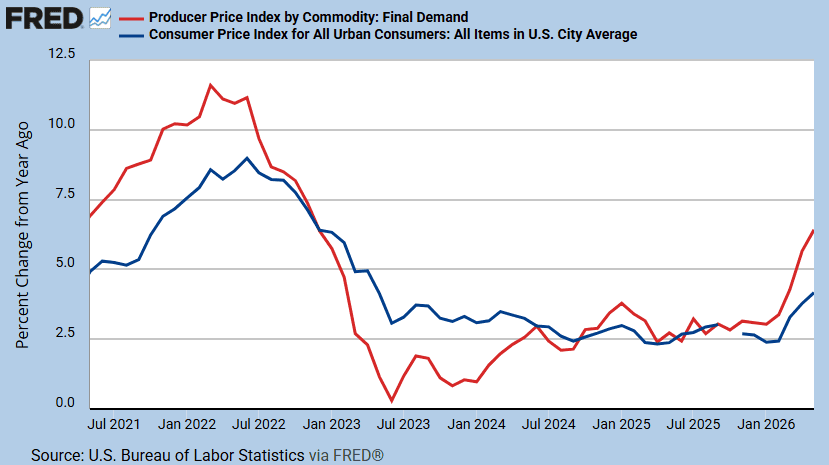
Source: U.S. Bureau of Labor Statistics, Federal Reserve Bank of St. Louis
CLOSING STATEMENT
Looking Ahead
With the third quarter now underway, attention is turning to second quarter earnings season, which kicks off in the coming weeks. Following two consecutive quarters of earnings growth above 20%, investors will be watching closely to see whether corporate America can maintain its impressive pace.
Inflation, and to a lesser extent the labor market, will remain key areas of focus for investors as they assess the Federal Reserve’s path for interest rates. The next FOMC meeting is scheduled for July 29, and as of this writing, policymakers are expected to leave rates unchanged. Looking beyond July, however, market participants remain divided. While futures markets are currently pricing in the possibility of a rate hike before year-end, some investors view further tightening as unlikely, arguing that upcoming improvement in inflation and other economic data could lessen the need for additional action from the Fed. We will be watching and listening closely as the Fed’s new star player and his team navigate a crowded field of upcoming data points in the coming weeks.
Please reach out to one of your Account Officers or any member of our Executive Leadership Team to discuss topics raised in this letter or if we can assist you in any other way.
Meet The Plimoth Investment Advisors Executive Leadership Team

Steven A. Russo, CFA
Chairman of the Board
508‑591‑6202
srusso@pliadv.com

Louis E. Sousa, CFA
President & Chief Executive Officer
508‑675‑4313
lsousa@pliadv.com

Mark J. Gendreau, CFP ®
Senior Vice President & Chief Investment Officer
508-591-6211
mgendreau@pliadv.com

Edward J. Misiolek
Senior Vice President & Operations Officer
508‑675‑4316
emisiolek@pliadv.com

Teresa A. Prue, CFP®
Senior Vice President &
Head of Fiduciary Services and Administration
508‑591‑6221
tprue@pliadv.com
